

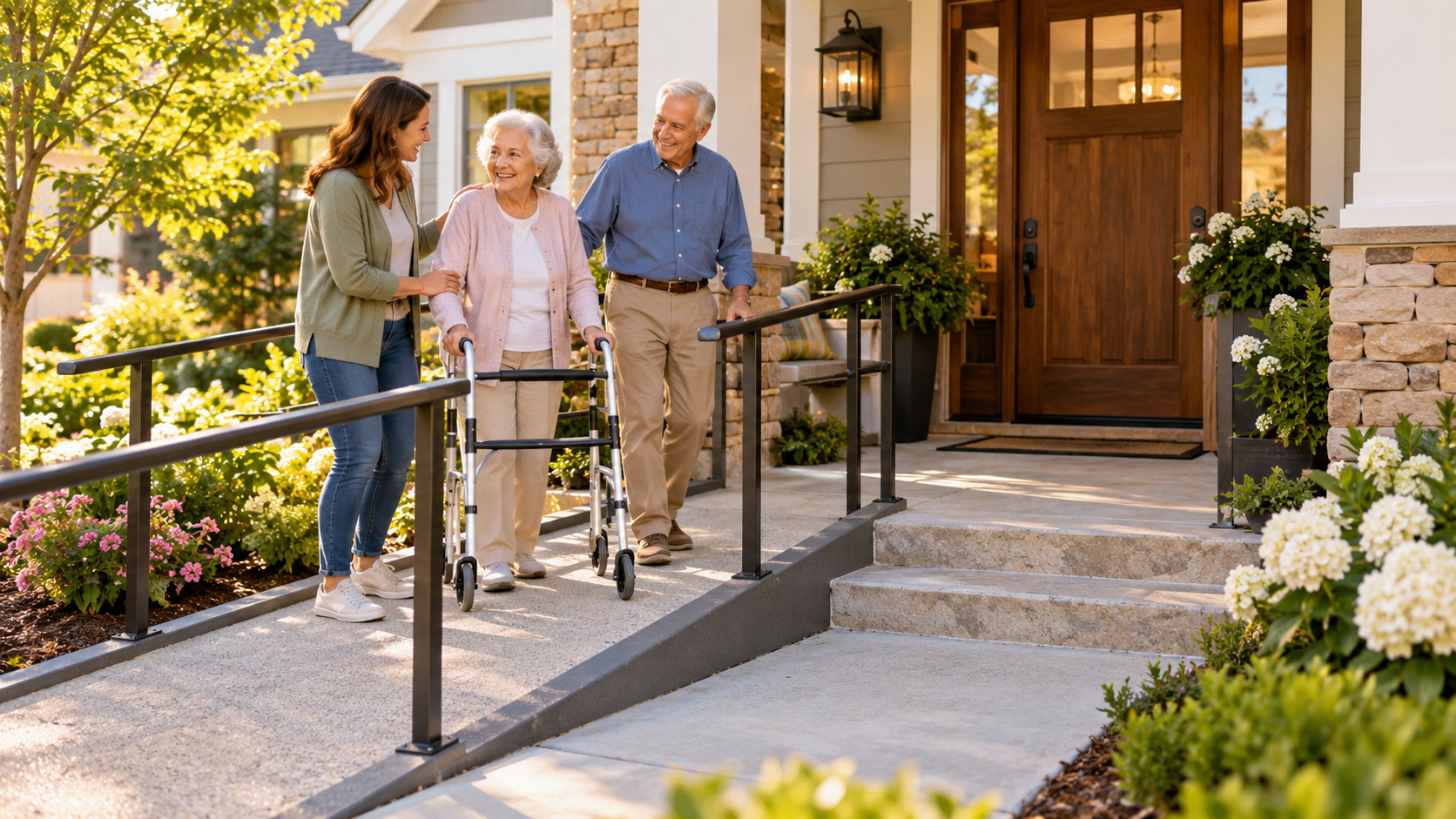
Your front entrance is more than just a doorway—it’s the first point of welcome, comfort, and independence in your home.
But for older adults, people with limited mobility, wheelchair users, families with young children, or anyone recovering from an injury, even a small step, slippery pathway, or poorly lit doorway can turn entering the home into a challenge.
The good news? Making a home entrance safer and more accessible doesn’t always require a major renovation. Thoughtful changes—from better lighting to ramps and sturdy handrails—can make a noticeable difference.
Let’s explore practical ways to create an entrance that feels safe, comfortable, welcoming, and easy to navigate for everyone.
Why an Accessible Home Entrance Matters
Most of us walk through our front door without giving it much thought. However, an entrance can contain several potential obstacles:
- Uneven or cracked pathways
- Steep steps
- Slippery surfaces
- Poor lighting
- Narrow doorways
- High thresholds
- Difficult-to-use door handles
- Lack of handrails or support
These small barriers can become significant safety concerns for someone with mobility limitations.
An accessible entrance isn’t only about convenience. It can help people maintain independence, reduce the risk of falls, and move in and out of their homes with greater confidence.
And accessibility isn’t only useful for wheelchair users. Parents pushing strollers, people carrying groceries, visitors with luggage, children, and older family members can all benefit from an easier-to-use entrance.
1. Start With a Safe and Smooth Pathway
Accessibility begins before you reach the front door.
Take a close look at the pathway leading from the driveway, sidewalk, or parking area to the entrance. It should be as smooth, stable, level, and obstacle-free as possible.
Repair cracked or uneven paving and remove anything that could become a trip hazard, such as loose stones, exposed roots, hoses, or clutter.
If you’re choosing new materials, consider surfaces that provide good traction, especially during wet weather.
Quick Tip 💡
Walk from the street or driveway to your door and imagine navigating the route while using a cane, walker, wheelchair, or stroller.
You may notice obstacles that are easy to overlook during everyday use.
2. Consider Adding a Ramp
Steps can be one of the biggest barriers at a home entrance.
Where appropriate, installing a properly designed accessibility ramp can make entering and leaving the home much easier for wheelchair and mobility-aid users.
A good ramp should provide:
- A manageable slope
- A firm, non-slip surface
- Enough width for comfortable movement
- Secure handrails where required
- Safe landings at appropriate points
- Clear space near the doorway
Avoid makeshift solutions or ramps that are excessively steep. Accessibility ramps should be designed with safety, stability, and applicable building requirements in mind.
For homes where a permanent ramp isn’t suitable, certain portable or modular ramp solutions may offer another option, depending on the entrance and the user’s needs.
3. Install Strong, Comfortable Handrails
For someone who feels unsteady on their feet, a reliable handrail can provide valuable support.
If your entrance includes stairs or a ramp, consider adding secure handrails that are easy to grip.
Where practical, having rails on both sides can provide additional support.
Check existing rails regularly. A handrail that moves, wobbles, or is difficult to hold can create another hazard instead of improving safety.
Think of handrails as more than a finishing touch—they can provide an important point of stability every time someone enters or leaves the home.
4. Brighten the Entrance
Poor visibility can dramatically increase the chance of trips and falls.
Your entrance should be well illuminated so people can clearly see:
- Steps
- Ramps
- Pathway edges
- Door locks
- Thresholds
- Changes in surface height
Consider lighting along pathways as well as near the door.
Motion-activated lighting can be particularly convenient because visitors don’t have to search for a switch in the dark.
Solar pathway lights may also help improve visibility in certain outdoor areas, although primary entrance lighting should be dependable enough to provide adequate illumination whenever needed.
A brighter entrance doesn’t just improve accessibility—it can also make your home feel warmer and more welcoming.
5. Make the Door Easier to Use
Sometimes, the biggest challenge isn’t reaching the door. It’s opening it.
Heavy doors, stiff locks, small knobs, and awkward handles can be frustrating for people with reduced hand strength or limited dexterity.
Consider replacing traditional round knobs with lever-style handles, which can often be operated with less gripping and twisting.
You may also want to check whether the door:
- Opens smoothly
- Requires excessive force
- Provides enough clear width
- Has an easy-to-operate lock
- Allows enough space to maneuver nearby
For households where accessibility is a major priority, an automatic or power-assisted door system may also be worth considering.
6. Pay Attention to Door Thresholds
That small raised strip at the bottom of a doorway might not seem significant, but it can create a considerable obstacle for wheels and a tripping risk for people who shuffle their feet.
Where possible, consider a low-profile or accessible threshold that creates a smoother transition between outdoor and indoor surfaces.
If eliminating the height difference isn’t practical, an appropriately designed threshold ramp may help provide an easier transition.
Small details like this can significantly improve the overall usability of an entrance.
7. Make Surfaces Slip-Resistant
Rain, snow, moisture, fallen leaves, and even morning dew can make outdoor surfaces dangerously slippery.
Choose entrance materials with good traction and keep pathways clean and well maintained.
Pay particular attention to:
- Steps
- Ramps
- Porches
- Tiles
- Decking
- Doorway areas
Outdoor mats should also be checked carefully. A mat that curls, moves, or bunches up can become a trip hazard.
Select a low-profile, slip-resistant mat that stays securely in place.
8. Keep the Entrance Free From Clutter
A beautiful entrance doesn’t need to be crowded.
Decorative pots, shoes, packages, garden equipment, children’s toys, and seasonal decorations can quickly reduce the amount of clear walking space.
Try to maintain an unobstructed route from the pathway to the door.
This becomes especially important for people using walkers or wheelchairs, who may require additional room to turn and position themselves comfortably.
Simple and spacious often works best.
9. Use Visual Contrast to Highlight Hazards
Not every accessibility improvement needs to involve construction.
Visual contrast can make steps, edges, handles, and changes in elevation easier to notice.
For example, contrasting strips along stair edges may help define individual steps more clearly for people with reduced vision.
Similarly, choosing a door handle that stands out against the door can make it easier to locate.
Thoughtful use of contrast can create an entrance that is both functional and visually attractive.
10. Consider a Small Resting Area
If space allows, adding a bench or sturdy seat near the entrance can be incredibly helpful.
Older adults or people with limited stamina may appreciate somewhere to pause while unlocking the door, waiting for transportation, putting on shoes, or simply catching their breath.
Just make sure the seating doesn’t block the primary accessible route.
A small resting spot can transform an entrance from simply functional into genuinely comfortable.
11. Use Smart Technology for Extra Convenience
Modern technology can make everyday entrances easier to manage.
Depending on the needs of the household, useful features might include:
Smart locks – Reduce the need to handle or turn traditional keys.
Video doorbells – Allow residents to see and communicate with visitors before opening the door.
Motion-activated lights – Illuminate the entrance automatically.
Keypad or keyless entry – Provide convenient access without searching for keys.
Automatic door openers – Can provide greater independence for some users with significant mobility limitations.
Technology shouldn’t make an entrance unnecessarily complicated, though. Choose features that are simple and practical for the people who will actually use them.
12. Look at the Entrance From the User’s Perspective
One of the best ways to improve accessibility is to involve the person who will benefit from the changes.
Ask questions such as:
Where do you feel least steady?
Is the door difficult to open?
Can you comfortably reach the lock or handle?
Is there enough room to turn your walker or wheelchair?
Do you feel confident using the entrance at night?
Accessibility works best when improvements are based on real-life needs rather than assumptions.
For significant modifications, consulting an occupational therapist, accessibility specialist, contractor, or other qualified professional can also help identify solutions suited to the home and its occupants.
Small Changes Can Make a Big Difference
Creating a safer and more accessible home entrance doesn’t necessarily mean completely redesigning the front of your house.
Sometimes it begins with something as simple as:
✨ Replacing a loose handrail
✨ Installing brighter lighting
✨ Removing a trip hazard
✨ Changing a difficult door knob
✨ Adding a non-slip surface
✨ Creating more space around the doorway
The goal is simple: everyone should be able to approach, enter, and leave the home as safely and comfortably as possible.
Accessibility also doesn’t have to make a home feel institutional. With thoughtful planning, ramps, rails, lighting, pathways, landscaping, and entrance hardware can be incorporated beautifully into the design of the property.
When safety, accessibility, and good design work together, the result is an entrance that doesn’t simply look welcoming—it truly welcomes everyone.
“A welcoming home begins at the door—but a truly thoughtful home makes sure everyone can reach it.”
leave a comment